Walk through an enterprise software vendor’s website today and the word “chatbot” has quietly been replaced by “agent.”
That’s not entirely a coincidence, and it’s not entirely marketing either.
Some of what is being rebranded reflects a genuine shift in what AI software can do. Some products, however, are still fundamentally doing what traditional chatbots did — just under newer terminology.
For software buyers, knowing the difference is becoming increasingly useful.
What’s Actually Driving the Shift From Chatbots to AI Agents?
The underlying technology has changed.
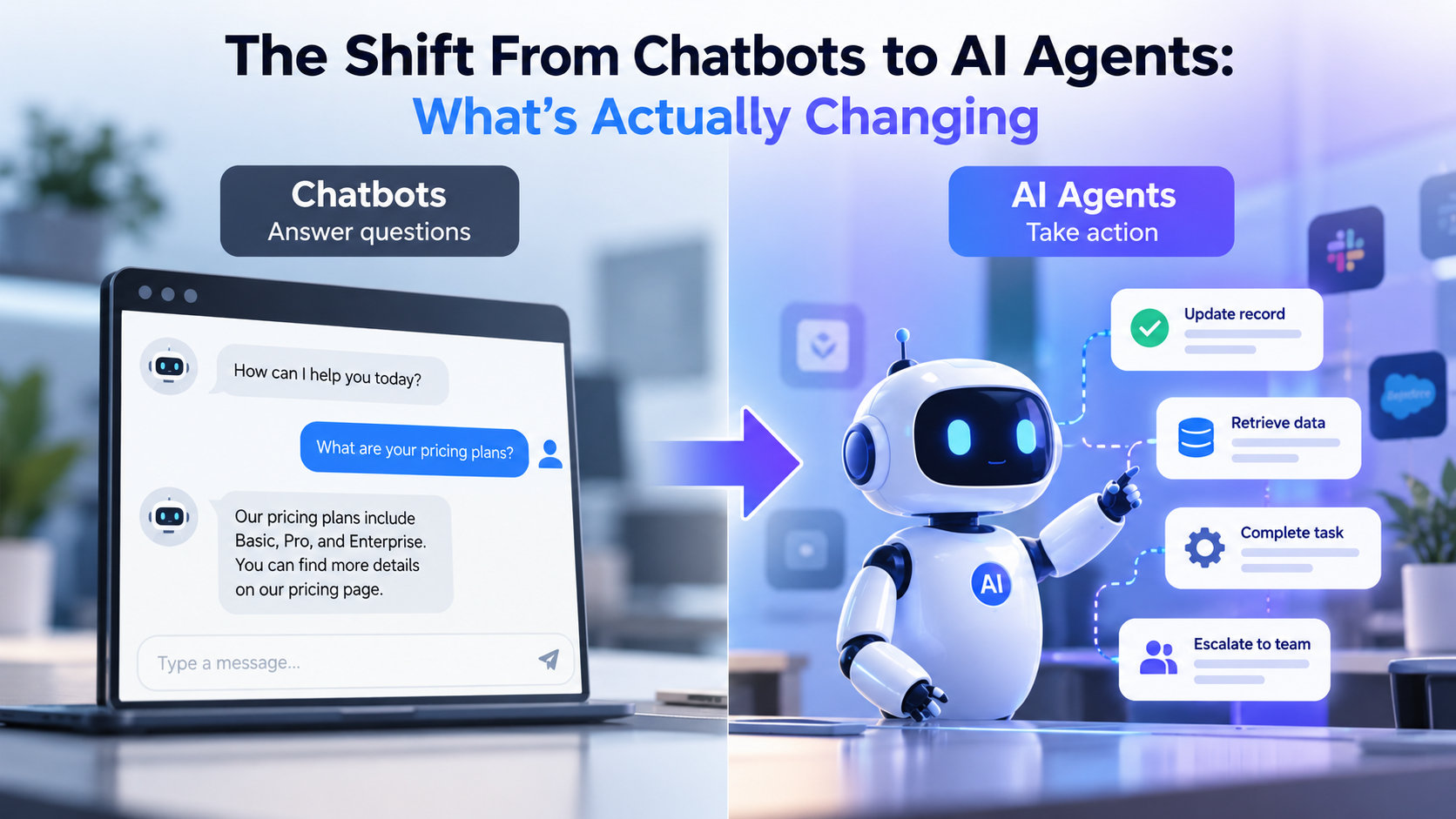
Modern language models can support systems that plan multi-step tasks, interact with external tools, and take actions beyond simply generating a response.
That makes it practical for some AI systems to do things such as:
- Issue a refund
- Update a customer record
- Escalate an issue
- Retrieve information from another system
- Complete several steps as part of one workflow
The important distinction is that the system isn’t limited to answering a question.
It can potentially take action to complete a task.
That’s a meaningful change from the traditional chatbot model, particularly when these capabilities are integrated into production software and business workflows.
When Is an AI Agent Really Just a Rebranded Chatbot?
The word “agent” doesn’t automatically mean a product has fundamentally changed.
Consider a support bot that answers questions using a company’s knowledge base.
If the product still primarily:
- receives a question,
- retrieves relevant information, and
- generates an answer,
then changing the product label from chatbot to AI agent doesn’t necessarily make it an agent in a meaningful operational sense.
The terminology may have changed while the underlying user experience remains largely the same.
For buyers, the better question isn’t:
“Does this vendor call its product an AI agent?”
It’s:
“What can the system actually do?”
AI Agents vs Chatbots: The Difference Buyers Should Look For
The simplest way to think about the distinction is response versus action.
| Traditional chatbot | AI agent |
|---|---|
| Primarily answers questions | Can potentially complete tasks |
| Usually responds to a user prompt | May plan multiple steps |
| Often works within a defined conversation | Can interact with external tools or systems |
| Knowledge retrieval is often central | Action execution can be central |
| Human may perform the next step | System may perform the next step |
This doesn’t mean every chatbot is simple or every AI agent is autonomous.
The important point is that the label alone isn’t enough to evaluate capability.
What This Means for Software Buyers
The shift in terminology has two practical implications.
1. Older software comparisons may use different terminology
As vendors reposition products around AI agents and agentic AI, older comparison articles and category pages may continue using terms such as chatbot, AI chatbot, or conversational AI.
That can make the software landscape harder to interpret.
A product may have changed substantially since an older article was published. Conversely, a newer “AI agent” label may describe functionality that is not dramatically different from what the product offered before.
Buyers should therefore look beyond the category name and examine the current capabilities of the product.
2. Ask what the product can actually do
Instead of asking:
“Is this an AI agent?”
ask:
“What multi-step task can this product complete?”
Then look for specifics:
- What systems can it access?
- What actions can it take?
- Can it execute multiple steps?
- What requires human approval?
- How does it handle failures?
- Can users review or override actions?
Those questions provide considerably more useful information than the word agent on a product page.
Where AI Agents Are Heading
The more meaningful long-term shift may not be the terminology at all.
It’s the expectation that AI software should increasingly complete tasks rather than simply answer questions.
That doesn’t mean traditional chatbots disappear.
Simple question-and-answer use cases can still be appropriate for a chatbot, and adding agentic capabilities isn’t necessarily worth the additional complexity for every workflow.
Instead, the market is likely to contain a spectrum of AI systems from conversational tools that primarily provide information to systems capable of carrying out increasingly complex workflows.
For software buyers, understanding where a product sits on that spectrum may matter more than the category label attached to it.
Final Takeaway
The move from chatbots to AI agents isn’t simply a terminology change but not every “agent” represents a fundamental product shift either.
The useful distinction for buyers is what happens after the conversation.
Does the software simply provide an answer?
Or can it take the appropriate actions to help complete the task?
That’s the question worth asking when evaluating the next generation of AI software.
Explore AI Software
Want to see how software vendors are positioning their AI products?
[Browse Software & Services →]
More in Industry Insights
Explore more guides and insights in this MarstechHQ Learn category. Browse Industry Insights →